What OpenTracy gives you
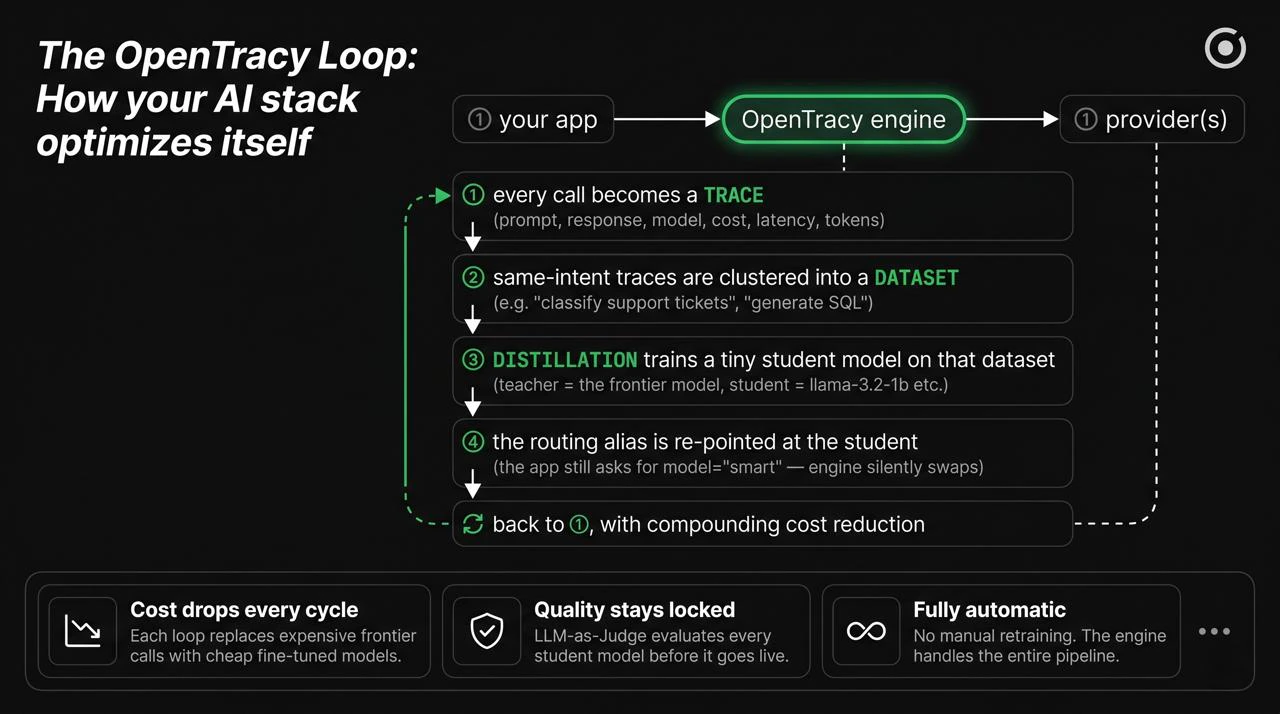
Drop OpenTracy in where your OpenAI SDK sits today. Every request becomes a trace. Same-intent traces cluster into a dataset. Datasets train a distilled student model that matches your teacher’s output on your traffic. The routing layer swaps the student in under your app through an alias — your code never changes, your cost curve goes down.Install
pip install and you can route on Linux (x86_64 / ARM64), macOS
(Apple Silicon), or Windows (x86_64).
Then jump to the Quickstart.
The loop, one step at a time
Your app calls the engine
Point your OpenAI SDK (or any of the 13 providers) at OpenTracy. No code
changes beyond
base_url.Every call becomes a trace
Prompt, response, model, cost, latency, tokens — persisted to ClickHouse
automatically.
Traces cluster into a dataset
Same-intent traces are grouped and labeled (e.g. “classify support tickets”,
“generate SQL”).
A student model gets distilled
The teacher (GPT-4o, Sonnet, …) labels the dataset; a tiny student
(llama-3.2-1b, qwen3-0.6b, …) fine-tunes to match.
Alias re-points at the student
model="smart" now resolves to the distilled student. Your app code
never changed.Quickstart
Five minutes: install, route your first request, see cost + latency metadata.
Pipeline
The full story — request → trace → dataset → student → alias.
Traces
What we capture per request, where it lives, how it becomes training data.
Distillation
Turn your teacher’s output on your traffic into a cheap custom student.
Why OpenTracy exists
Every team running LLMs in production hits the same wall:- GPT-4o / Claude Sonnet works — but it’s expensive.
- GPT-4o-mini / Haiku is cheap — but quality risk is real on hard prompts.
- Fine-tuning a smaller model is the right answer — but it needs a dataset you don’t have, training infrastructure you don’t want, and a way to actually serve the new model behind your existing code.
How this documentation is organized
Concepts
The “why” — traces, datasets, auto-routing, distillation, and the pipeline that ties them together.
Guides
Task-oriented walkthroughs — drop-in OpenAI replacement, self-hosting, Python SDK.
API Reference
Every function in the Python SDK with arguments, return types, and examples.
GitHub
Source code, issues, and the CI workflow that ships the wheels.